THIS COURSE IS OVER!!!! No way! I actually really enjoyed this course and it was one of my best courses this year (I hope my grades agree haha! 😂). I loved the fact that it was 100% course work- that was my favorite part. I loved watching most of the films. My favorite film from this course is “Middle of Nowhere”, I promise you it’s not only because Omari Hardwich (Derek) was in it.
I must admit I preferred the tutorials more than the lectures. I liked the presentations and the one on one feeling that was in our tutorial meetings. Whenever the guys would voice their opinions on whatever we were discussing I would always want to hear how they think or see female struggles. And as I typed that I remembered Delroy’s reaction -in the corner, to me saying something about men that he didn’t agree with- just popped into my head …. aahhh the pleasures of face to face classes.
I would’ve loved to have completed this class in a face to face manner, but life had other plans. Despite this, I am grateful that I have an understanding lecturer who posted course materials for me (& the other students to access) after class. The online discussions weren’t the same as face to face, and I ended up missing a few classes :(. In order to catch up with the class, I had to read the materials that were posted, and this was so hard because I couldn’t focus on school.
This course is not to be taken lightly. It focused on issues that needed to be exposed and highlighted in society and in the films themselves. I am 10000% grateful for the knowledge I garnered from this course, as it relates to stereotypes, fair representation of women and minorities, different cultures and cultural acceptances, the oppositional gaze, narrative structure and I truly could go on. This course allowed me to use the discussions in class and apply them to everyday, real life analysis and even analyze other films.
This course reminded me of the connection between life and art, and how much power that connection wields. And so, for my last journal entry, I would like to recommend LITS 2907 WOMEN IN CINEMA IN THE FACULTY OF HUMANITIES AND EDUCATION @ UWI to anyone who would be interested. 15/10 recommended! Thanks for everything miss! I really appreciate it!
Now let me continue working on my final essay >.<. 0/10 recommended guys, send help!
Pariah is a coming of age story and a coming out story. The film stars a black, gay, female teenager and her relationship with her family and friends. What I loved most about this film is that it exposes the complexities of the black community and the diversity of Black women. The protagonist, Alike, struggles to find herself and her identity in a world that expects her to conform to the “norms” of society. The time period is also important because open/ queer sexual preferences were not as accepted back then as they are today.
Watch the trailer!! And then watch the movie. 10/10 recommended by yours truly.
This coming of age film was incredibly empowering. To see Alike find her voice and “come out” to her family was so amazing. Mainly because for me, it represented strength and growth for the character and the society in general. A society must be ready to experience change in order to move forward, and while everyone won’t accept everything, it is important to allow people to be themselves and not feel trapped. More specifically as it relates to the black community and the black woman, the sexual identity is explored within the context of a gay woman. This is powerful because black women are constantly seen as sexual beings (to the man/ for the man), and I can’t help but wonder if men refuse to accept this sexual preference because they feel as though they are losing their “power”, “right” or place in society. Hmm 🤔
You know what I realized too? The titles of these films are so important. The fact that the film is titled “Pariah” which means an outcast or rejected member of society, can also symbolize many other black women who don’t conform to societal norms. Additionally, it represents a clear insight into how people who are deemed as different are treated in society. THEREFORE, JUST BY THE TITLE ALONE IT BECOMES CLEAR THAT THE DIRECTORS WILL BE ADDRESSING AND PRESENTING INSIGHT INTO THE LIVES OF THOSE WHO FEEL REJECTED! I find it fitting, that the character is black, female and lesbian- given that these are the most rejected and abandoned groups in society.
As we discussed in class, the black female is basically a personal and psychological journey, as the protagonist finds a way to decide for herself what she wants in life and pave her own path of self acceptance and awareness. In this film, Alike becomes aware of society and herself and this knowledge is essential in the process of empowerment because it serves as the foundation for the next step. This next step can be in the form of breaking down barriers and stereotypes in the black, gay community, and paving away for eventual acceptance.
The narrative of a gay black woman exposes audiences to how diverse and dynamic the race can be. It exposes the idea that we (as black people) are not just one fixed group. The film also made clear representation of the flaws to our ways and the generalized stereotypes of gays as well. It was so easy for Alike’s mother (& the man the father had an altercation with) to suspect that she is gay, but no one suspected Bina to be gay. Alike exhibited certain “characteristics” or gay stereotypes or traits of being gay, and so that is how society saw her.
Bina’s character also exposes the diversity of the black woman. I could even go as far as to say Bina represents how society would want women to be seen, and she is Alike’s opposite. Bina is light skinned while Alike is dark, Bina is feminine and would be classified as “beautiful” while Alike is a “tomboy” and some might find her unattractive. And yet, Bina sneaks and hides things from her family just like Alike. Bina likes girls but is afraid to admit it, she asks Alike to not tell anyone that they slept together. Similarly, Alike lies about going to the club (to find girls) and she has two different appearances at school and at home.
This two sided perspective allows for the understanding of trying to hide the side of them that society doesn’t accept. This is usually viewed as being defiant by not complying to society’s norms. This idea has been challenged by Black feminist critics and from within the Black community including Black gays and lesbians who have criticized same sexual politics that deny their right to be fully accepted within the churches, families and other Black community organizations. The normalization of heterosexism is therefore challenged by gays being opened about their sexuality. Take for example Alike’s best-friend Laura. She was extremely open and honest about her sexuality. Her character represents those who are perceived as being defiant
The film ends with a beautiful poem by Alike. The poem makes mention of being “broken open” and this (to me) represents breaking down barriers and stereotypes and paving way for a new narrative for black women and the black community in general. In fact, I do believe that women in cinema (actresses and writers/ directors) encounters their own version of being shunned from society and not being able to access the same opportunities as their counterparts. Since it is true that life imitates art, the struggles represented by Alike are indeed similar to women in cinema and had it not been for their contributions today, women- black women would not have been fairly represented.
While it is not a film film (haha!) I was able to pin point similarities between this film and the series “How to get away with murder”. The main star “Annalise Keating” played by Viola Davis, is an adequate representation of black women, the way we are in society. In several interviews conducted about the series she makes mention of not wanting to fit inside a bubble or make herself smaller in order to fit the narrative that she was told to play. She decided it was important for her to be seen on screen without makeup of wigs, and to be as barefaced as the regular black woman. This representation allowed for black women everywhere to be able to see a character they could relate to. Viola Davis has won an Emmy award for this role and she has received worldwide recognition for constantly trying to “break open” and break through the barriers set by society.
I’m getting emotional. Check out the poem by Alike while I go dry my tears.
“Heartbreak opens onto the sunrise for even breaking is opening and I am broken, I am open. Broken into the new life without pushing in, open to the possibilities within, pushing out. See the love shine in through my cracks? See the light shine out through me? I am broken, I am open, I am broken open. See the love light shining through me, shining through my cracks, through the gaps. My spirit takes journey, my spirit takes flight, could not have risen otherwise and I am not running, I am choosing. Running is not a choice from the breaking. Breaking is freeing, broken is freedom. I am not broken, I am free.” Alike (Pariah)
Julie Dash Julie Dash Julie Daaassshhh!!! Round of applause for this talented women! I am grateful for her contributions to cinema and the representation of women.
Now that I’ve given my gratitude and praise to her as an amazingly creative soul, let me just express how much I hated this film.
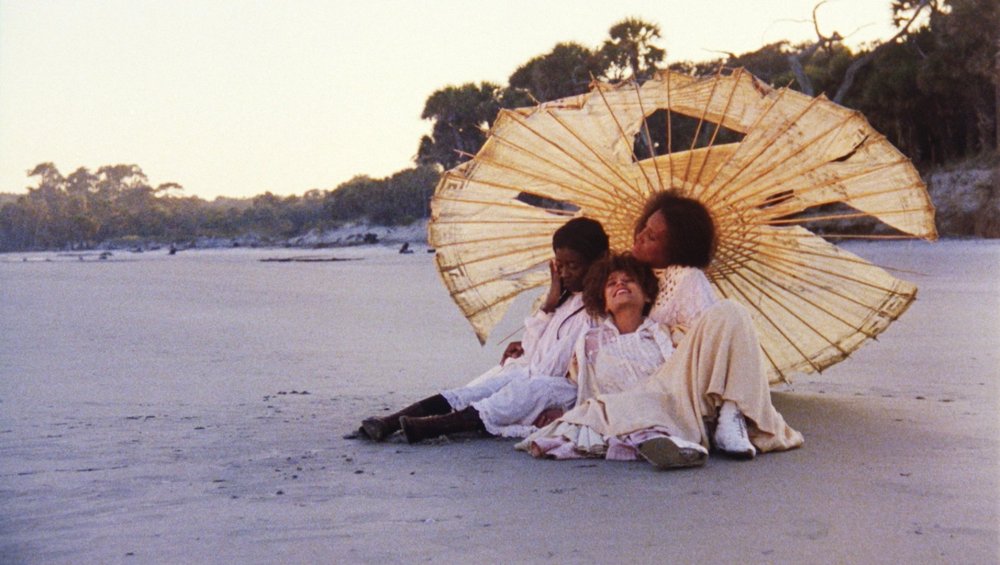
Credit where credit it due, I respected and admired the Cinematograph throughout the film. I loved that it was isolated from the rest of “society” and focused on a specific group of people. For me, this isolation made the dynamics of culture and family even stronger. The film is incredibly “dream like”. It takes us back in time as it’s set in the past. It’s incredibly specific about time and location.
And it’s on that note ladies and gentlemen that I become confused and aggravated with this film. The progression of the scene is not linear; it is fragmented. Therefore we become unaware of what is going on. I also loved that I’m not the only one who felt like this. When we were having the discussion in class (aahh, good old face to face) most people if not everyone was confused as to who is speaking and from what time period … it was mentally exhausting.
Despite the fact that I don’t personally like the film, I do believe this film is important in its contributions towards women in cinema- specifically, BLACK women in cinema. Daughters of the Dust focused on GENERATIONS of Gullah women (and men). It shared perspective and personalities that clashed and this- sometimes, presented humor to the audience.
Daughters of the Dust is about the story of generations of Gullah people, that focuses on the preservation of culture and their connection with their ancestors. The film exposed the presence of women and their strengths particularly as it relates to their cultural and societal responsibilities.
I did admire the film taking a different approach to storytelling by including the perspective of black characters and GLORIFYING THEM! In a successful attempt to recall, record and reclaim history, the film tries to move past the sense of shame that has lingered in the past, and replaces that shame with pride admiration and gratefulness.
The film focuses on the women who were the carriers of the traditions and belief of the Gullah people. The clashing ideas of Nana Peazant and her “children” who wanted to leave the island to venture out into the world represented the fear of change and the fear of stagnation and missing opportunities equally. This film exposes the strength and determination of women and more importantly, our ability to adapt and grow. The clash was also as a result of the generation gap between the women and their priorities. I particularly enjoyed the power that the women were given, and the important role they played in the film. This opposes the experience of so many women.
In an interview, Julie Dash expressed what it was like being on set with men- and being filmmakers. When asked “as a woman, it’s gotta me hard right?” As it relates to working on set with men, she said “and you learn that in film school, so it’s like please… get outta here with this”. Dash made it clear that she just had to be strong and stand up for whatever direction she wanted to take the film in, and ignore her male counterparts who would often times try to downplay her ideas and not take her seriously.
Here’s a clip from the interview! Check it out!
All in all it was a rough film to watch because it was hard to follow the flow of information. Apart from that it was a good watch. I personally enjoyed the light that the women were shown in, and I couldn’t help but wonder if the key to women empowerment is distancing ourself and our people from the rest of the world. Maybe isolation is key, who knows. On a serious note, I do believe that society and “norms” play a major role in the gender stereotypes and expectations, once these Gullah people created their own society they maintained their culture and women had power!
Who’s coming with me on an island so we can start over? Let’s do it in the name of equality! #TeamNanaPeazant clearly I still agree that they shouldn’t leave the island.




 Nasika’s Film Blog!